

| 24 Hours of Daytona |


| LE MANS 24 vs DAYTONA 24 |


24 Hours of Daytona
Location
Length
Type of Track
Lighting
Time in Dark
Date
First Race
Sanctioning Body
Length
Type of Track
Lighting
Time in Dark
Date
First Race
Sanctioning Body
Daytona Int'l Speedway
Daytona Florida USA
3.56-mile (5.73 km)
Banked oval track, utilizing
an infield road course section
The track is lighted
12 hours
Last weekend of January or
first weekend of February,
1966
IMSA under the jurisdiction of
the ACCUS arm of the FIA
Daytona Florida USA
3.56-mile (5.73 km)
Banked oval track, utilizing
an infield road course section
The track is lighted
12 hours
Last weekend of January or
first weekend of February,
1966
IMSA under the jurisdiction of
the ACCUS arm of the FIA
Circuit de la Sarthe
Le Mans, France
8.467-mile (13.626 km)
Comprises public roads and
private race track sections
No track lighting
8 hours
June
1923
FIA
Le Mans, France
8.467-mile (13.626 km)
Comprises public roads and
private race track sections
No track lighting
8 hours
June
1923
FIA


| Daytona Track |
| Le Mans Course |
Copyright © 2023 IndySpeedway.com All Rights Reserved
24 Hours of Le Mans
| VS |
| Comparing The 24 Hours of Le Mans and the 24 Hours of Daytona |
OTHER NOTES:
Both series have several classes of cars that race at the same
time and with several drivers for each car, who take turns driving.
Some teams compete in both races.
Rain is a possibility at either track.
The cars at Le Mans have to rely on their headlights at night but
more hours of night time racing occurs at Daytona.
While the cars are similar, the tracks are not -
Both series have several classes of cars that race at the same
time and with several drivers for each car, who take turns driving.
Some teams compete in both races.
Rain is a possibility at either track.
The cars at Le Mans have to rely on their headlights at night but
more hours of night time racing occurs at Daytona.
While the cars are similar, the tracks are not -
Historical Notes about Le Mans:
The race was not ran in 1936 or from 1940-1948.
The worst racing accident in history happened during the 1955 race at Le Mans when a
Mercedes-Benz 300 SLR crashed and exploded near a throng of spectators, killing the
driver and 82 spectators. Nearly 180 others were injured.
That terrible event resulted in Mercedes-Benz withdrawing from all factory-sponsored
motorsport. Mercedes-Benz returned to sports car racing as a factory team in 1997,
42 years later. Also, Switzerland banned auto racing after the crash. They lifted the
ban 67 years later in 2022.
Since the first race in 1923, the cars were lined up along the pit wall in the order they
qualified in. The drivers stood on the opposite side of the track, and would run to their cars
as the race was started. This starting method ended after 1970 due to safety - as some
drivers would not take the time to buckle themselves into the car at the start.
The race was not ran in 1936 or from 1940-1948.
The worst racing accident in history happened during the 1955 race at Le Mans when a
Mercedes-Benz 300 SLR crashed and exploded near a throng of spectators, killing the
driver and 82 spectators. Nearly 180 others were injured.
That terrible event resulted in Mercedes-Benz withdrawing from all factory-sponsored
motorsport. Mercedes-Benz returned to sports car racing as a factory team in 1997,
42 years later. Also, Switzerland banned auto racing after the crash. They lifted the
ban 67 years later in 2022.
Since the first race in 1923, the cars were lined up along the pit wall in the order they
qualified in. The drivers stood on the opposite side of the track, and would run to their cars
as the race was started. This starting method ended after 1970 due to safety - as some
drivers would not take the time to buckle themselves into the car at the start.

| 2021 24 Hours of Le Mans |
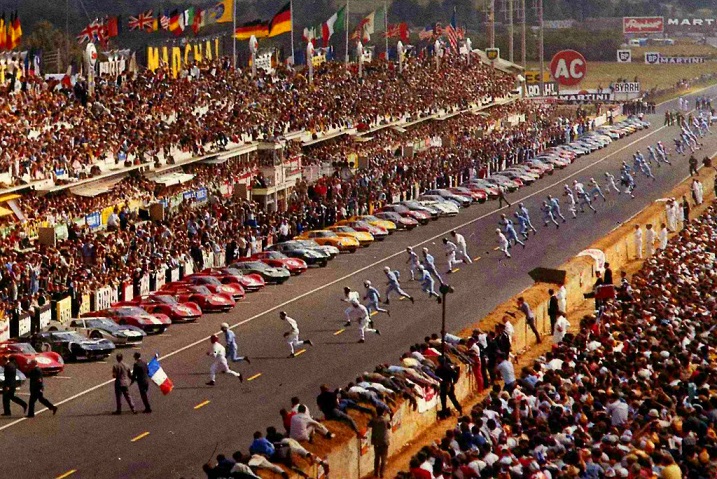
| 1969 24 Hours of Le Mans Start |

Due to the high-banked turns at Daytona, teams have to
adjust the cars for the transition to banking.
Since the Daytona course is so much shorter, that
translates to more traffic that the drivers have to deal with.
The cars at Le Mans reach higher speeds because the
longer track has a longer straight.
adjust the cars for the transition to banking.
Since the Daytona course is so much shorter, that
translates to more traffic that the drivers have to deal with.
The cars at Le Mans reach higher speeds because the
longer track has a longer straight.