| F1 Vs. INDYCAR - DRIVERS |
Copyright © 2025 IndySpeedway.com All Rights Reserved
| Formula One vs Indy Car A Modern Comparison |
| WHO ARE THE BEST DRIVERS? |
HOW DO WE DECIDE?
We could look at who has been winning this year.
That might help help us see who is currently the best in a particular series -
but not always. Maybe the best driver hasn't been winning because...
We could look at who has been winning this year.
That might help help us see who is currently the best in a particular series -
but not always. Maybe the best driver hasn't been winning because...
| Created in 1998 |
* his car is too slow
* or, his team has problems
* or, he's had really bad luck
* or, the team just doesn't have enough money
* or, his team is new or,
* he's suffering from an injury
* or, he's going through a divorce
etc, etc, etc.
* or, his team has problems
* or, he's had really bad luck
* or, the team just doesn't have enough money
* or, his team is new or,
* he's suffering from an injury
* or, he's going through a divorce
etc, etc, etc.
Road Courses VS Ovals
Another problem is that drivers compete in different series and different types
of cars! How do you compare them?
Many people claim that a driver who races on a road course not only has to
change speed more drastically, but turn right as well as left. But on a oval,
there is a constant faster speed. The faster you go, the less time you have to
make decisions. There is a concrete wall, there's generally more passing, and
the danger is higher.
Indycar VS Stockcars
Some folks claim that there is a smaller margin of error in stockcars because
they race closer together. But this is because they can. They can usually rub
and bump each other without too much concern. But doing that with open-
wheelers usually results in a devastating accident. When you see an IRL car
whose wheels are inches from another car, it is a much more dangerous
situation!
Also, open-wheelers are more aerodynamic and travel at faster speeds, but
when they wreck, since they are not usually all close as flies, not as many cars
get wrecked. Often times in Nascar, you are at the mercy of what happens in
front of you more than in open-wheel series.
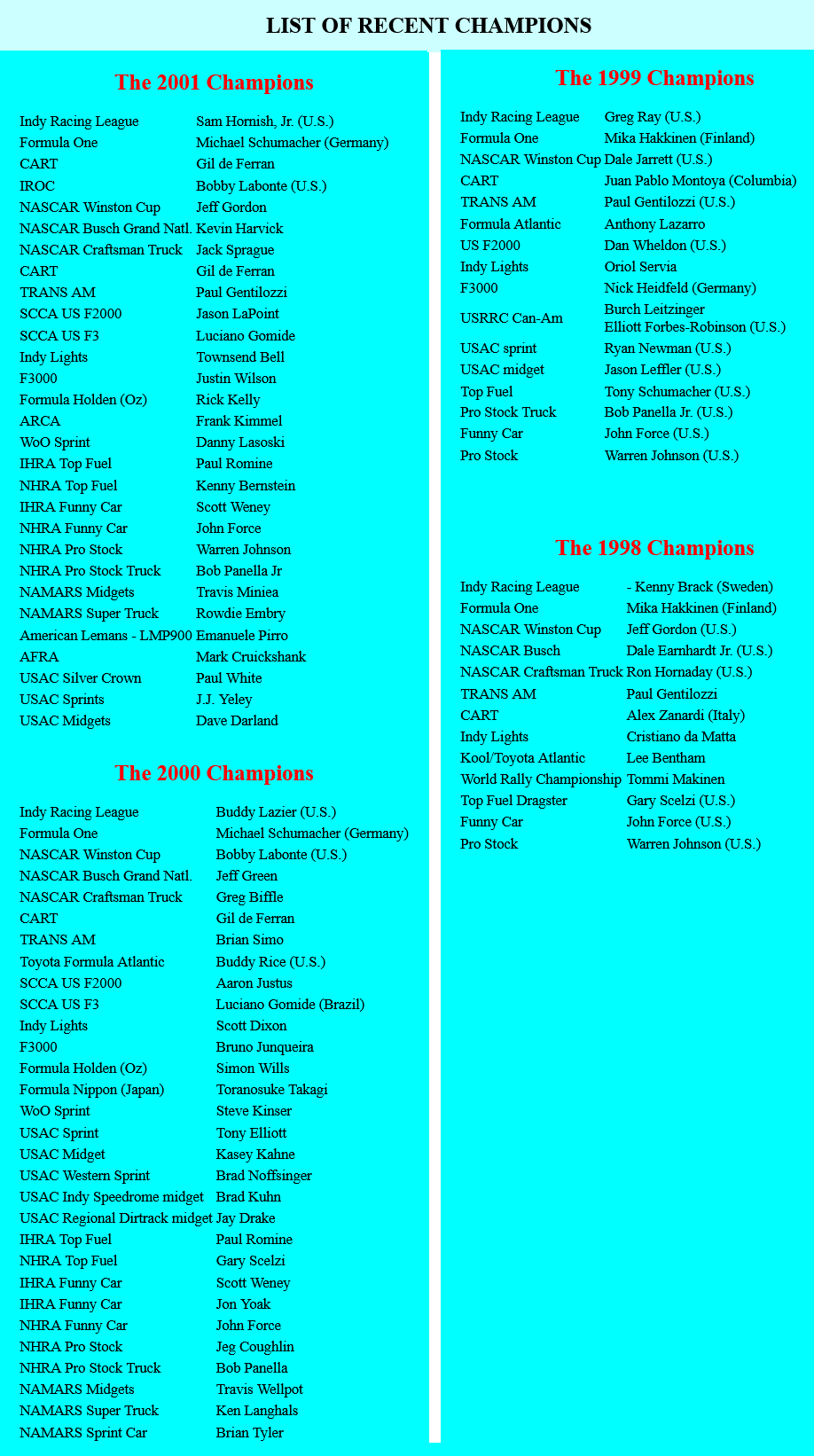
Anyway, one famous attempt has been made to compare drivers - IROC!
of cars! How do you compare them?
Many people claim that a driver who races on a road course not only has to
change speed more drastically, but turn right as well as left. But on a oval,
there is a constant faster speed. The faster you go, the less time you have to
make decisions. There is a concrete wall, there's generally more passing, and
the danger is higher.
Indycar VS Stockcars
Some folks claim that there is a smaller margin of error in stockcars because
they race closer together. But this is because they can. They can usually rub
and bump each other without too much concern. But doing that with open-
wheelers usually results in a devastating accident. When you see an IRL car
whose wheels are inches from another car, it is a much more dangerous
situation!
Also, open-wheelers are more aerodynamic and travel at faster speeds, but
when they wreck, since they are not usually all close as flies, not as many cars
get wrecked. Often times in Nascar, you are at the mercy of what happens in
front of you more than in open-wheel series.
Anyway, one famous attempt has been made to compare drivers - IROC!
| IROC |
The International Race Of Champions is an American racing series that has
been around for 25 years.
They pit stars from different series together in an attempt to see who is the
best. IROC holds four races each year. They race only on large ovals and in
equally prepared closed-wheel cars that resemble Trans-Am or stock cars.
been around for 25 years.
They pit stars from different series together in an attempt to see who is the
best. IROC holds four races each year. They race only on large ovals and in
equally prepared closed-wheel cars that resemble Trans-Am or stock cars.

Drivers from different series are invited to participate. Jacky Ickx, Emerson
Fittipaldi, Richard Petty, Gordon Johncock, Jody Scheckter, Johnny Rutherford,
Buddy Baker, James Hunt, Denny Hulme and Martin Brundle are some of the
drivers who have competed over the years.
F1 drivers have not competed in the last several years.
This year (2001) we had drivers from NASCAR, IRL, & CART competing.
List of IROC Races & Champions
IROC Homepage
Fittipaldi, Richard Petty, Gordon Johncock, Jody Scheckter, Johnny Rutherford,
Buddy Baker, James Hunt, Denny Hulme and Martin Brundle are some of the
drivers who have competed over the years.
F1 drivers have not competed in the last several years.
This year (2001) we had drivers from NASCAR, IRL, & CART competing.
List of IROC Races & Champions
IROC Homepage
| Race of Champions - ROC |
Another racing series has also come on the scene - the Race of Champions.
This series takes 3 drivers each from different countries and pits them against
each other in off-road rally cars. Typically each team consists of a motorcycle
champion. Generally, your professional Rally drivers win. It is still interesting to
see though, as this year (2002) we had drivers from CART, F1, and Winston
Cup competing for their respective countries including Jeff Gordon, Cristiano Da
Matta, and Nick Heidfeld.
Information on this series can be found at their website: ROC
This series takes 3 drivers each from different countries and pits them against
each other in off-road rally cars. Typically each team consists of a motorcycle
champion. Generally, your professional Rally drivers win. It is still interesting to
see though, as this year (2002) we had drivers from CART, F1, and Winston
Cup competing for their respective countries including Jeff Gordon, Cristiano Da
Matta, and Nick Heidfeld.
Information on this series can be found at their website: ROC
| Is Jeff Gordon a Wimp? |
Does Winston Cup require that much experience, or are their drivers just old
farts? Bruno Junqueira, a CART rookie who qualified for 2001 Indy 500, said he
was baffled by the physical condition that stock-car drivers seem to be in. His
favorite example: Bobby Hamilton who was so exhausted by driving 500 miles
last month at Talladega that he couldn't stand up to be interviewed.
"They couldn't make it for half of an F3000 (road) race," he said. Bruno was
last year's F3000 champion.
My neighbor's friend said that the little smart-alek wouldn't last half-way through
Bristol!
Then my neighbor intervened with, "These racers are different types of
animals, like football players are different than basketball players!
Well I thought that sounded like a good excuse to remember incase you ever
get into this argument in the pub!
farts? Bruno Junqueira, a CART rookie who qualified for 2001 Indy 500, said he
was baffled by the physical condition that stock-car drivers seem to be in. His
favorite example: Bobby Hamilton who was so exhausted by driving 500 miles
last month at Talladega that he couldn't stand up to be interviewed.
"They couldn't make it for half of an F3000 (road) race," he said. Bruno was
last year's F3000 champion.
My neighbor's friend said that the little smart-alek wouldn't last half-way through
Bristol!
Then my neighbor intervened with, "These racers are different types of
animals, like football players are different than basketball players!
Well I thought that sounded like a good excuse to remember incase you ever
get into this argument in the pub!
| Money Matters?? |
Money helps buy the best equipment and the best employees.
F1 teams in the 90's are very large and have a lot of money.
The teams employ anywhere from 100 to 500 people and are worth
$50 million to a $1 billion. These teams are by far the richest race
teams in the world.
Why is it that Americans race on ovals? This seems to go all the
way back to the beginnning of auto racing. Europe had a decent road
structure before the auto was invented. The 1800's found America's
horses and wagons blazing trails and muddy ruts as the westward
expansion continued. When auto racing began at the beginning of the
century, Americans turned to their dirt horse tracks to race on.
Europeans skipped their "grass" horse tracks and used their roads
instead. Hence separate traditions began that continue to this day, a
century later.
If F1 spends the most money on drivers, does this mean they
have the best drivers?! Sounds logical. However, they do not tap the
well of oval track drivers where most Americans race. Jeff Gordon is
never going to get a chance at F1, even though he might be the best
driver in the world. The world of F1 would like to have an American
driver too! Not only because they now have an American Grand Prix,
but because of American sponsors and the fact that they call their
Championship the "World" Drivers Championship. The last American to
get a chance to race in F1 was Michael Andretti, and this was because
he had road course experience in the CART series. It didn't seem to go
him much good though.
F1 teams in the 90's are very large and have a lot of money.
The teams employ anywhere from 100 to 500 people and are worth
$50 million to a $1 billion. These teams are by far the richest race
teams in the world.
Why is it that Americans race on ovals? This seems to go all the
way back to the beginnning of auto racing. Europe had a decent road
structure before the auto was invented. The 1800's found America's
horses and wagons blazing trails and muddy ruts as the westward
expansion continued. When auto racing began at the beginning of the
century, Americans turned to their dirt horse tracks to race on.
Europeans skipped their "grass" horse tracks and used their roads
instead. Hence separate traditions began that continue to this day, a
century later.
If F1 spends the most money on drivers, does this mean they
have the best drivers?! Sounds logical. However, they do not tap the
well of oval track drivers where most Americans race. Jeff Gordon is
never going to get a chance at F1, even though he might be the best
driver in the world. The world of F1 would like to have an American
driver too! Not only because they now have an American Grand Prix,
but because of American sponsors and the fact that they call their
Championship the "World" Drivers Championship. The last American to
get a chance to race in F1 was Michael Andretti, and this was because
he had road course experience in the CART series. It didn't seem to go
him much good though.
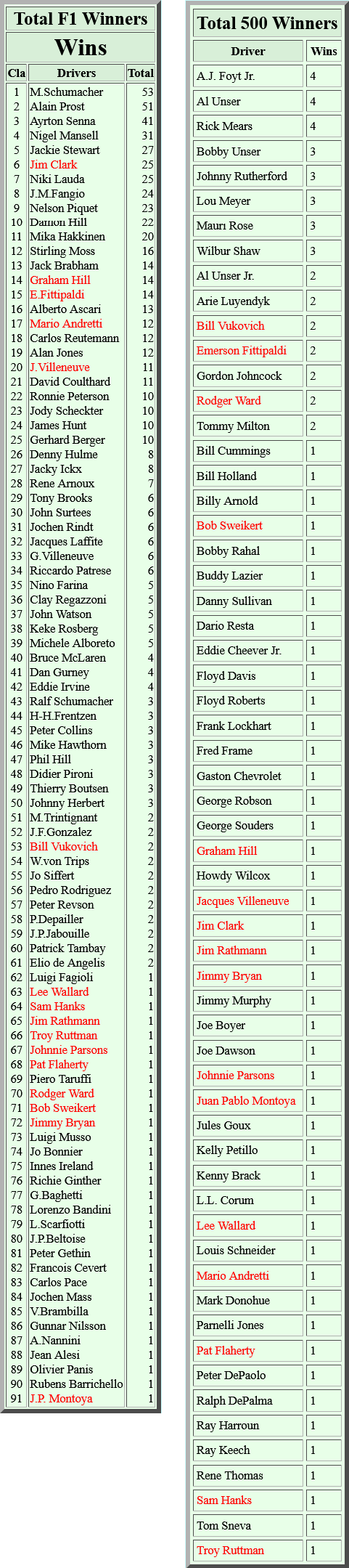
| Drivers in red won F1 and Indy! Last updated Nov 20, 2001 |
| Indy 500 & F1 Race Champions |
In 1996, the IRL was formed, which caused some CART team-owners to boycott
the Indy 500. The following is a list of the 1995 IndyCar drivers, who are still
active, and which series they now race in.
the Indy 500. The following is a list of the 1995 IndyCar drivers, who are still
active, and which series they now race in.
(What really hurt Indy Car was the retirement of many legendary drivers all around
the same time. Mario Andretti, A.J. Foyt, Al Unser Sr., Johnny Rutherford, Danny
Sulivan, Gordon Johncock and Emerson Fittipaldi all left.)
the same time. Mario Andretti, A.J. Foyt, Al Unser Sr., Johnny Rutherford, Danny
Sulivan, Gordon Johncock and Emerson Fittipaldi all left.)
IRL - Scott Brayton (died in practice crash at Speedway in '96)
IRL - Raul Boesel
IRL - Eddie Cheever - Indy 500 Winner
IRL - Scott Goodyear
IRL - Buddy Lazier - Indy 500 winner
IRL - Arie Luyendyk - 2 Time Indy 500 winner
IRL - Robbie Buhl
IRL - Mike Groff
IRL - Robbie Groff
IRL - Eliseo Salazar
IRL - Marco Greco
IRL - Al Unser Jr. switched from CART in 2000 - 2 Time Indy 500 Winner
IRL - Michael Andretti switched from CART in 2003 - Prior experience: 11 attempts at Indy.
IRL - Gil de Ferran switched from CART in 2002- Prior experience: 1 year in Indy
IRL - Raul Boesel
IRL - Eddie Cheever - Indy 500 Winner
IRL - Scott Goodyear
IRL - Buddy Lazier - Indy 500 winner
IRL - Arie Luyendyk - 2 Time Indy 500 winner
IRL - Robbie Buhl
IRL - Mike Groff
IRL - Robbie Groff
IRL - Eliseo Salazar
IRL - Marco Greco
IRL - Al Unser Jr. switched from CART in 2000 - 2 Time Indy 500 Winner
IRL - Michael Andretti switched from CART in 2003 - Prior experience: 11 attempts at Indy.
IRL - Gil de Ferran switched from CART in 2002- Prior experience: 1 year in Indy
CART- Paul Tracy - returned to Indy 500 in 2002
CART- Jimmy Vasser - returned to Indy 500 in 2000
CART- Adrian Fernandez - Prior Experience: 2 years in Indy
CART- Bryan Herta - Prior Experience: 2 years in Indy
CART- Andre Robeiro - Prior Experience: 1 year in Indy
CART- Christian Fittipaldi - Prior Experience: 1 year in Indy
CART- Jimmy Vasser - returned to Indy 500 in 2000
CART- Adrian Fernandez - Prior Experience: 2 years in Indy
CART- Bryan Herta - Prior Experience: 2 years in Indy
CART- Andre Robeiro - Prior Experience: 1 year in Indy
CART- Christian Fittipaldi - Prior Experience: 1 year in Indy
CART - Bobby Rahal, retired in 97. He competed in 13 Indy 500's - Started IRL
team in 2003
CART - Scott Pruett, moved to Nascar in 2000. He competed in 4 Indy 500's.
and then there's Robby Gordon who has raced in 6 Indy 500's, Nascar, CART,
IRL, and off road. For 2001, Robby raced some Winston Cup and in the Indy 500
again for A.J. Foyt.
May 17, 1999 - Robbie was comparing the IRL and Champ cars:
"All kidding aside, the cars are more similar than they are different. I like these
IRL cars. They're very mechanical-friendly, if that makes sense. Not as high-tech
as the CART cars, which make them a little bit easier to set up. Not as many
variables. As for actually driving the cars, they feel very similar, once again. The
one thing that you notice is the horsepower difference, which is about 200 in favor
of the turbocharged Champ Cars. In terms of handling, what you want with the IRL
car is the same thing you want with the Champ Car ... you want it to handle well.
When the cars are handling well, a race car is a race car. "
team in 2003
CART - Scott Pruett, moved to Nascar in 2000. He competed in 4 Indy 500's.
and then there's Robby Gordon who has raced in 6 Indy 500's, Nascar, CART,
IRL, and off road. For 2001, Robby raced some Winston Cup and in the Indy 500
again for A.J. Foyt.
May 17, 1999 - Robbie was comparing the IRL and Champ cars:
"All kidding aside, the cars are more similar than they are different. I like these
IRL cars. They're very mechanical-friendly, if that makes sense. Not as high-tech
as the CART cars, which make them a little bit easier to set up. Not as many
variables. As for actually driving the cars, they feel very similar, once again. The
one thing that you notice is the horsepower difference, which is about 200 in favor
of the turbocharged Champ Cars. In terms of handling, what you want with the IRL
car is the same thing you want with the Champ Car ... you want it to handle well.
When the cars are handling well, a race car is a race car. "
| IRL vs CART |
The Best Driver in the World?
Michael Schumacher earned $80 million in 2001, easily making him the highest paid
driver in the world. Schumacher, arguably the best race car driver of all time, broke
many records in Formula One in 2001. He clinched his 4th World Drivers Championship
by August and he kept on winning.
He surpassed Ayrton Senna for the highest number of laps lead in a lifetime. He
surpassed Alain Prost for the most number of career victories. He tied Nigel Mansell's
record for the most wins in a season. Michael won 11 poles and 9 races in the 16-race
2001 season, and he finished 2nd five times. He now has a total of 53 career wins.
Yet, there are still some records for Michael to shoot for. Juan Fangio won 5 F1
Championships and Ayrton Senna won 65 pole positions. Note: Juan Fangio was able
to switch cars and choose the best car in the race in the 1950's!
Michael Schumacher earned $80 million in 2001, easily making him the highest paid
driver in the world. Schumacher, arguably the best race car driver of all time, broke
many records in Formula One in 2001. He clinched his 4th World Drivers Championship
by August and he kept on winning.
He surpassed Ayrton Senna for the highest number of laps lead in a lifetime. He
surpassed Alain Prost for the most number of career victories. He tied Nigel Mansell's
record for the most wins in a season. Michael won 11 poles and 9 races in the 16-race
2001 season, and he finished 2nd five times. He now has a total of 53 career wins.
Yet, there are still some records for Michael to shoot for. Juan Fangio won 5 F1
Championships and Ayrton Senna won 65 pole positions. Note: Juan Fangio was able
to switch cars and choose the best car in the race in the 1950's!
Who is the best driver of all time?
Excerpts from "Who Is The Greatest Of Them All?" by Dick
Mittman, the Senior Editor for the Indianapolis Motor
Speedway.
Wins alone would point to Petty. He scored his
200th and final victory on July 4, 1984, at Daytona
International Speedway in front of President
Reagan.
Petty has 95 more victories than David Pearson,
who holds down second place on the all-time
NASCAR win list. But Petty started 1,184 races,
compared to 574 for the "Silver Fox." Neither
Petty nor Pearson ever started the Indianapolis
500.
Petty won the Daytona 500 a record seven times
and the championship the same number of times.
Earnhardt, who was fatally injured in a last-lap
crash at Daytona last February, finally won his
only Daytona 500 in 1998 but matched Petty's
record of seven Winston Cup titles. Earnhardt's 76
career race victories is sixth all-time, coming in
676 starts.
Both Foyt and Andretti not only drove in the
Daytona 500 but also won it.
Foyt is the all-time Indy car race winner at 67,
including four in the Indianapolis 500. He also
started at Indy 35 consecutive times, an incredible
record. And in 1967, he shared the winning ride
with Dan Gurney in the demanding Le Mans 24
Hours sports-car race.
Andretti is second on the Indy-car victory list with
52. He also is second on the Indianapolis 500
races started list with 29 and third in laps led, 556,
yet he only won the world's most famous race
once, in 1969. Foyt won the national championship
seven times, Mario four times.
On the plus side for Andretti is that he drove in
128 Formula One races, won 12 and the 1978
World Championship. He has finished no better
than third at Le Mans.
Andretti started a record 407 races in an Indy car,
and, combined with his F1 starts, his start total in
the top two forms of open-wheel racing is a
remarkable 535. Foyt started 369 Indy-car races.
Michael Schumacher, who now owns four World
Championships with two different teams, has
strong credentials for consideration as the
greatest driver. He won consecutive titles with
Benetton in 1994-95 and has followed with two
more with Ferrari in 2000-01. He was never
seriously challenged this season and wrapped up
the title with four races remaining.
Excerpts from "Who Is The Greatest Of Them All?" by Dick
Mittman, the Senior Editor for the Indianapolis Motor
Speedway.
Wins alone would point to Petty. He scored his
200th and final victory on July 4, 1984, at Daytona
International Speedway in front of President
Reagan.
Petty has 95 more victories than David Pearson,
who holds down second place on the all-time
NASCAR win list. But Petty started 1,184 races,
compared to 574 for the "Silver Fox." Neither
Petty nor Pearson ever started the Indianapolis
500.
Petty won the Daytona 500 a record seven times
and the championship the same number of times.
Earnhardt, who was fatally injured in a last-lap
crash at Daytona last February, finally won his
only Daytona 500 in 1998 but matched Petty's
record of seven Winston Cup titles. Earnhardt's 76
career race victories is sixth all-time, coming in
676 starts.
Both Foyt and Andretti not only drove in the
Daytona 500 but also won it.
Foyt is the all-time Indy car race winner at 67,
including four in the Indianapolis 500. He also
started at Indy 35 consecutive times, an incredible
record. And in 1967, he shared the winning ride
with Dan Gurney in the demanding Le Mans 24
Hours sports-car race.
Andretti is second on the Indy-car victory list with
52. He also is second on the Indianapolis 500
races started list with 29 and third in laps led, 556,
yet he only won the world's most famous race
once, in 1969. Foyt won the national championship
seven times, Mario four times.
On the plus side for Andretti is that he drove in
128 Formula One races, won 12 and the 1978
World Championship. He has finished no better
than third at Le Mans.
Andretti started a record 407 races in an Indy car,
and, combined with his F1 starts, his start total in
the top two forms of open-wheel racing is a
remarkable 535. Foyt started 369 Indy-car races.
Michael Schumacher, who now owns four World
Championships with two different teams, has
strong credentials for consideration as the
greatest driver. He won consecutive titles with
Benetton in 1994-95 and has followed with two
more with Ferrari in 2000-01. He was never
seriously challenged this season and wrapped up
the title with four races remaining.
This is the 11th F1 season for Schumacher, 32.
His 52 wins have come in just 158 starts. Prost
started 199 races between 1980-93 and won
championships in 1985, 1986, 1989 and 1993.
Another factor favoring Schumacher is that he
already has led 87 Grands Prix for 3,053 laps,
while Prost was a pacesetter in 84 races for
2,684 laps.
Brazilian Ayrton Senna, whose career was cut
short -- like Earnhardt's -- by death in a crash,
won 41 times in 161 starts and led 2,986 laps in
86 races.
Schumacher's victory in last year's inaugural SAP
United States Grand Prix at Indy was particularly
impressive. No team had practiced at the new
2.606-mile, 13-turn road course, yet Schuey
dominated in practice, qualifying and the race. He
might have won by half-a-lap but for his own late
inattention that caused him to briefly spin off
course and trim his imposing lead.
One thing Schumacher hasn't done is take a shot
at the Indianapolis 500. Some other F1 stars of
the past, such as Jimmy Clark, Graham Hill,
Jackie Stewart and Emerson Fittipaldi did. Clark,
Hill and Emmo won it, and Stewart had the 1966
race in his crosshairs until an engine problem took
him out with 11 laps to go.
Then we come to Gordon. He grew up in the
shadow of the Speedway yet hasn't raced there in
an open-wheel car. He chose to go to stock-car
racing and has won 57 times in just 283 races. He
raced to victory in the first Brickyard 400 in 1994
and after only eight events already is a three-time
winner. He has won on the big ovals, short tracks
and road courses, and soon will pass the late
Earnhardt as the sport's all-time money-winner.
Possibly all of these drivers are second to the late
Juan Manuel Fangio. All this Argentine did was
start in the front row in 48 of 51 races, win 24,
capture 29 poles and earn a podium finish 35
times. He led 39 races for 1,348 laps and won
championships in 1951, 1954, 1955, 1956 and
1957.
The drawback in selecting him as the greatest is
the strength of competition in the 1950s and the
lack a strong racing season. Still, he won a career
high 47 percent of the races he started, and that
says a lot for his talent. All any driver can do is
beat the competitors who race against him each
time.
As far as Schumacher is concerned, it is great for
American racing fans that Speedway President
Tony George brought Formula One back to the
US., and particularly to the Speedway. This has
allowed them to see Schuey in person and make a
personal judgment on where he fits among the all
time greats of the sport.
His 52 wins have come in just 158 starts. Prost
started 199 races between 1980-93 and won
championships in 1985, 1986, 1989 and 1993.
Another factor favoring Schumacher is that he
already has led 87 Grands Prix for 3,053 laps,
while Prost was a pacesetter in 84 races for
2,684 laps.
Brazilian Ayrton Senna, whose career was cut
short -- like Earnhardt's -- by death in a crash,
won 41 times in 161 starts and led 2,986 laps in
86 races.
Schumacher's victory in last year's inaugural SAP
United States Grand Prix at Indy was particularly
impressive. No team had practiced at the new
2.606-mile, 13-turn road course, yet Schuey
dominated in practice, qualifying and the race. He
might have won by half-a-lap but for his own late
inattention that caused him to briefly spin off
course and trim his imposing lead.
One thing Schumacher hasn't done is take a shot
at the Indianapolis 500. Some other F1 stars of
the past, such as Jimmy Clark, Graham Hill,
Jackie Stewart and Emerson Fittipaldi did. Clark,
Hill and Emmo won it, and Stewart had the 1966
race in his crosshairs until an engine problem took
him out with 11 laps to go.
Then we come to Gordon. He grew up in the
shadow of the Speedway yet hasn't raced there in
an open-wheel car. He chose to go to stock-car
racing and has won 57 times in just 283 races. He
raced to victory in the first Brickyard 400 in 1994
and after only eight events already is a three-time
winner. He has won on the big ovals, short tracks
and road courses, and soon will pass the late
Earnhardt as the sport's all-time money-winner.
Possibly all of these drivers are second to the late
Juan Manuel Fangio. All this Argentine did was
start in the front row in 48 of 51 races, win 24,
capture 29 poles and earn a podium finish 35
times. He led 39 races for 1,348 laps and won
championships in 1951, 1954, 1955, 1956 and
1957.
The drawback in selecting him as the greatest is
the strength of competition in the 1950s and the
lack a strong racing season. Still, he won a career
high 47 percent of the races he started, and that
says a lot for his talent. All any driver can do is
beat the competitors who race against him each
time.
As far as Schumacher is concerned, it is great for
American racing fans that Speedway President
Tony George brought Formula One back to the
US., and particularly to the Speedway. This has
allowed them to see Schuey in person and make a
personal judgment on where he fits among the all
time greats of the sport.