Contact About Site Map Privacy Copyright © 2009 IndySpeedway.com All Rights Reserved
| DAN'S PHOTO JOURNALS |



Race News
Teams/Drivers
Race Link
Race Schedules
MotoGP
F1 vs. Indycar
Race Photos
Indy 500 Memorial
General Info
Tickets For Sale
Tickets Wanted
Ticket Info
Where To Sit
Maps
Parking
Transportation
Hotels
Camping
Things To Do
What To Take
Food & Drink
Cool Tales
The Party
Indy City Guide
Site Map
FAQ
Contact
Teams/Drivers
Race Link
Race Schedules
MotoGP
F1 vs. Indycar
Race Photos
Indy 500 Memorial
General Info
Tickets For Sale
Tickets Wanted
Ticket Info
Where To Sit
Maps
Parking
Transportation
Hotels
Camping
Things To Do
What To Take
Food & Drink
Cool Tales
The Party
Indy City Guide
Site Map
FAQ
Contact


Read about my experience at Andy's Fast Track Racing School

February 26, 2009
Hillenburg resurrecting the Rock with a steady effort
By Joe Menzer, NASCAR.COM
ROCKINGHAM, N.C. -- The date was March 3, 1991, so long ago that
Kyle Petty was one of the hottest drivers in NASCAR. Andy
Hillenburg was an obscure rookie driver making his first start in
what was then known as the Winston Cup Series.
Having founded the Fast Track High Performance Driving School for
aspiring racers only two years earlier, Hillenburg had qualified to
start 32nd in a field of 40 cars. He did so while driving a car that
normally was used by students in his driving school.
Hillenburg resurrecting the Rock with a steady effort
By Joe Menzer, NASCAR.COM
ROCKINGHAM, N.C. -- The date was March 3, 1991, so long ago that
Kyle Petty was one of the hottest drivers in NASCAR. Andy
Hillenburg was an obscure rookie driver making his first start in
what was then known as the Winston Cup Series.
Having founded the Fast Track High Performance Driving School for
aspiring racers only two years earlier, Hillenburg had qualified to
start 32nd in a field of 40 cars. He did so while driving a car that
normally was used by students in his driving school.
"The bad part was it also had a driving school engine in it. We
probably had 10,000 miles on the thing," Hillenburg said.
That became evident on Lap 6 of the GM Goodwrench 500 at
North Carolina Speedway, a nifty 1.017-mile oval long thought of as
a driver's dream.
"That was the first time I ever spun out a stock car," said
Hillenburg, a native of Indianapolis who also once drove an
open-wheel car in the Indianapolis 500. "Going into Turn 3 very
early in the race, the crankshaft broke in half and locked up -- and
I did a 360 through 3 and 4. I stopped, and didn't even know what
had happened until I tried to re-fire the motor and realized that
I blew an engine. That was my first foray into Cup racing."
Hillenburg was 28 years old then. He could not have envisioned
that at 45, nearly five years into his retirement as a driver with
limited success, he would own the place where he made his Cup
debut before a packed house of roughly 64,500 rabid NASCAR
fans.
Cup racing left the place affectionately known as the Rock on Feb.
22, 2004, when Matt Kenseth won the Subway 400 there. Having
lost its more coveted fall Cup race a year earlier when it was
moved to Phoenix, about 50,000 fans showed up to witness the
track's Cup finale.
The facility's final race date basically was bought and sold by
Speedway Motorsports Inc. chairman Bruton Smith, who used the
purchase to secure a second annual Cup date for Texas Motor
Speedway. The Rock subsequently sat dormant, ignored and
largely forgotten, for the next four and a half years until SMI
sold it at auction to Hillenburg for $4.4 million in October of
2007.
"Owning a race track is something I've wanted to do for a long
time -- but I never imagined owning this particular one,"
Hillenburg said. "I just feel like it's a jewel that fell out of the
pocket, and we were there to pick it up. There is so much history
and tradition here."
When he arrived at auction to place what proved to be the winning
bid for the track, Hillenburg was hopeful but not certain he was
going to walk away with his jewel. And as he would soon find out, he
wasn't quite sure exactly what he was getting himself into.
"I felt like I had a chance at it. But I don't want to say I thought
I would get it," Hillenburg said. "A lot of times, I believe that
things work out like they're supposed to -- and at the auction, if I
wasn't the only one, I was one of the very few who wanted to
keep racing here. I think that might have had something to do with
it.
"There were those who supposedly wanted to buy it and sell it off
piece by piece. There were rumors of the scrap deal, and there
were rumors of [it being used for] government training exercises.
And actually [Cup owner Richard] Childress did bid on it, just for a
testing facility. There was a lot of that stuff."
Hillenburg wanted no part of any of the above. He wanted to buy
the Rock for only one reason -- to bring racing back to it. He
promised to do so within 13 months of making the purchase.
Only a few weeks earlier, Hillenburg had placed a phone call to his
longtime friend, general contractor and home builder Robert
Ingraham. They had known each other for more than 20 years.
"I'm gonna buy the speedway," Hillenburg told Ingraham.
Ingraham thought he might have a bad connection.
"You're doing what?" he asked, incredulous.
"I'm gonna buy the speedway," Hillenburg said.
Not long thereafter, Ingraham's phone rang again. Hillenburg was
on the other end and matter-of-factly stated, "Well, I bought it."
"You did WHAT???" Ingraham shouted into the phone.
Hillenburg was calling this time with an offer. He wanted
Ingraham to help bring the Rock back to life. There were fences
and walls to be rebuilt and repaired. There was grass to be
mowed, shrubbery to be pulled out and replaced, buildings to be
refurbished. There were all kinds of things for a general
contractor to get his hands on.
Ingraham agreed to help out with what he could. Semi-retired and
playing lots of golf 20 minutes down Highway 1 in Pinehurst, N.C.,
Ingraham soon discovered there was more to the "part-time job"
than he thought.
"He asked me to come and help bring a place that had been asleep
for four and a half years back awake. I mean, there are over 800
toilets in this place. It's 254 acres that had been sleeping,"
Ingraham said. "I don't get to play as much golf as I once played.
But I'm having fun."
Eventually, with Ingraham doing more and more, Hillenburg asked
him to come on-board full time as director of operations. That
deal was consummated right before Hillenburg made good on his
promise to bring racing back to the Rock within 13 months of his
purchase, as he hosted the first of a pair of 2008 ARCA races at
the facility.
There was much to be done to make it race-ready again. One day
Ingraham placed a call to Ronnie Chavis, the longtime general
manager of the facility and caretaker of the place during its
dormant years. Ingraham wanted to make sure he wouldn't
compromise anything by doing some serious digging around the
place.
"Ronnie, I'm getting ready to dig a hole. Where can I not dig?"
Ingraham asked.
"You can dig anywhere you want to, just don't dig in the infield,"
Chavis replied.
"Why is that?"
"You've got to remember that one of the guys who once ran this
place was in the funeral home business. We don't know what's
buried in there."
Two weeks prior to the first ARCA event, one of Hillenburg and
Ingraham's workers spied a fox roaming in the infield. Several
touchy phone calls and one trapping permit from the local game
warden later (he threatened to arrest Ingraham if he didn't get
the permit first), the fox was caught and planning for the event
continued.
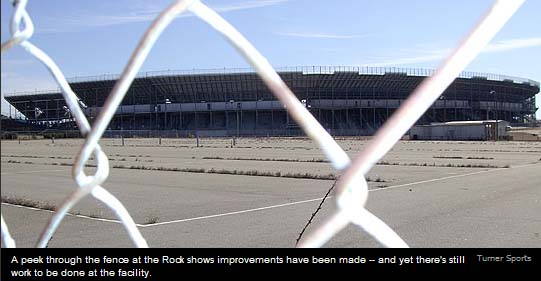
When the purchase of the track was made, the massive
backstretch grandstands were not included in the sale. Bruton
Smith wanted to take them out and use them in a drag strip he
was planning to build near Lowe's Motor Speedway in Charlotte,
where he transplanted the 30,000 seats (they comprise the John
Force Grandstand at that facility).
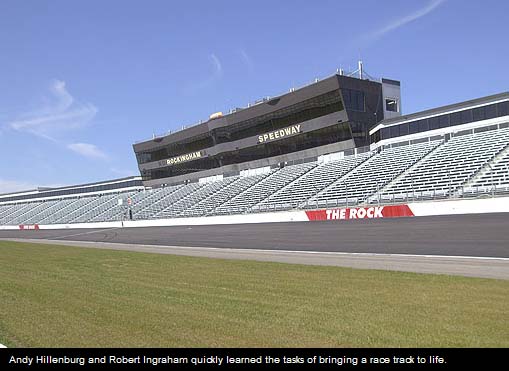
That left Hillenburg with 34,500 seats. He and Ingraham
wondered how many they could fill for the ARCA races -- and were
pleasantly surprised when they drew an estimated crowd of
18,000 for the second event that determined the ARCA champion
last spring. They knew local fans were embittered over the
sudden loss of the Cup races years earlier, but what they found
was that their anger was not necessarily directed toward them.
The facility also drew 15,000 for the Polar Bear 150, a street
stock race held last Jan. 1. And it drew 10,000 for a USAR Pro Cup
Series event.
"I think their bitterness is more toward NASCAR, and more
toward Bruton. They're thinking like, 'Hey, you took our race
away.' It's not about us. It's about what happened to them. It's
kind of like a jilted lover, so to speak," Ingraham said of the fans.
"But the fan who does come back has a good time and maybe tells
a friend. And then they find out we're selling hamburgers for a
dollar less today than we did in 2004. So we're getting a few
more back at a time every day."
Hillenburg added: "I think we're over that. We got here to get it
going again, so we've gotten very big support. There have been a
lot of people that come to our races who hadn't been to races in a
number of years, since they lost the [Cup] race."
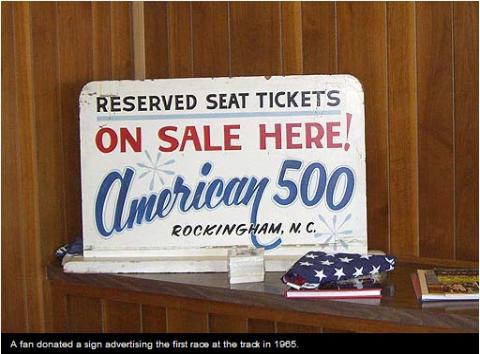
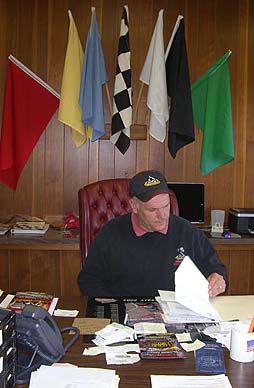
Shortly after purchasing the track, Hillenburg started receiving
unsolicited phone calls from fans. One said he had a sign promoting
the very first Cup race ever run at the Rock, won by the
legendary Curtis Turner in 1965. It was just sitting in his garage
and he wanted Hillenburg to have it. It now sits proudly in
Hillenburg's office. Another "fan," who apparently had made off
with dozens of photographs and plaques and other memorabilia
that had been left behind in the old press box, showed up and
delivered boxes of the stuff back to whom he now figured was its
rightful owner.
"When the track was sold the first time [to SMI], he didn't trust
that stuff not to disappear and he was hoping that someday it
could all be put up here again. It's history of the place. He said it
belongs here," Hillenburg said.
Hillenburg is cultivating the fan-friendly atmosphere, noting that
ticket prices for his two 2009 ARCA races run from $20 to $35
for adults, and $15 for children. Camping outside the track is
free, although fans have to pay for premier spots on the
backstretch in Thunder Alley or in the infield.
"I feel like you can bring a family of four here and have a great
time without breaking the bank," Hillenburg said.
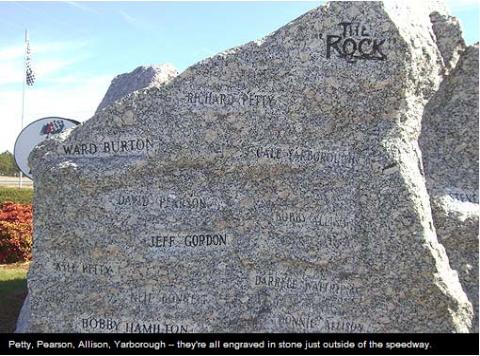
Those who won Cup races on the 1.017-mile oval between 1965 and
2004 read like a Who's Who in a catalogue of the best drivers
the sport has ever had. Among them: Richard Petty, David Pearson,
Bobby Allison, Cale Yarborough, Dale Earnhardt, Fred Lorenzen,
Donnie Allison, Darrell Waltrip, Bill Elliott, Neil Bonnett, Rusty
Wallace and Jeff Gordon. Most won there more than once, as did
Kyle Petty -- who not only won the race in 1991 when Hillenburg
made his Cup debut but also won three in a row at one point.
You can still see their names engraved on a giant rock in front of
the track's modest operational office building. Hillenburg calls
that "the Chapter One rock," and proudly shows off what he had
hauled in last year and calls "Chapter Two." The second boulder is
engraved with the names of winners of events since he took over
the operation, including Joey Logano and Clayton Rogers.
Nowadays, the current greats in the sport still come around --
perhaps even more often than in the past, just not in front of
huge, adoring crowds. They now come to the Rock to test -- and
not only on the oval where the series used to run but on the new
half-mile track out back that Hillenburg built to resemble the
Martinsville track where the Cup and Truck series still run.
It's all part of Hillenburg's grand plan. He already has officially
changed the name of his growing complex to Rockingham Raceway
Park. The old track has been renamed Rockingham Speedway, and
the new asphalt-and-concrete track -- which also includes an
asphalt quarter-mile circuit inside the half-miler -- is called Little
Rock.
He now uses the facility as a more permanent home to his
once-roaming Fast Track operation, and can offer schools for
wannabe drivers now on both short tracks and the oval. He said he
has about 30 dates per year booked for those, and envisions more.
He also rents out both of his tracks to NASCAR teams looking to
test. Business hasn't spiked as much as Hillenburg had hoped since
new rules eliminated testing at tracks where NASCAR-sanctioned
events are run, but it's brisk enough. Teams pay -- or split with
other teams -- fees that generally run about $5,000 per day for
up to five cars on one of the tracks. That covers the $1,200 per
day that it costs to keep emergency personnel on hand, and then
some.
But with a current average of only eight testing dates booked per
month, the facility still is struggling to keep all its bills paid and
turn a profit most months.
probably had 10,000 miles on the thing," Hillenburg said.
That became evident on Lap 6 of the GM Goodwrench 500 at
North Carolina Speedway, a nifty 1.017-mile oval long thought of as
a driver's dream.
"That was the first time I ever spun out a stock car," said
Hillenburg, a native of Indianapolis who also once drove an
open-wheel car in the Indianapolis 500. "Going into Turn 3 very
early in the race, the crankshaft broke in half and locked up -- and
I did a 360 through 3 and 4. I stopped, and didn't even know what
had happened until I tried to re-fire the motor and realized that
I blew an engine. That was my first foray into Cup racing."
Hillenburg was 28 years old then. He could not have envisioned
that at 45, nearly five years into his retirement as a driver with
limited success, he would own the place where he made his Cup
debut before a packed house of roughly 64,500 rabid NASCAR
fans.
Cup racing left the place affectionately known as the Rock on Feb.
22, 2004, when Matt Kenseth won the Subway 400 there. Having
lost its more coveted fall Cup race a year earlier when it was
moved to Phoenix, about 50,000 fans showed up to witness the
track's Cup finale.
The facility's final race date basically was bought and sold by
Speedway Motorsports Inc. chairman Bruton Smith, who used the
purchase to secure a second annual Cup date for Texas Motor
Speedway. The Rock subsequently sat dormant, ignored and
largely forgotten, for the next four and a half years until SMI
sold it at auction to Hillenburg for $4.4 million in October of
2007.
"Owning a race track is something I've wanted to do for a long
time -- but I never imagined owning this particular one,"
Hillenburg said. "I just feel like it's a jewel that fell out of the
pocket, and we were there to pick it up. There is so much history
and tradition here."
When he arrived at auction to place what proved to be the winning
bid for the track, Hillenburg was hopeful but not certain he was
going to walk away with his jewel. And as he would soon find out, he
wasn't quite sure exactly what he was getting himself into.
"I felt like I had a chance at it. But I don't want to say I thought
I would get it," Hillenburg said. "A lot of times, I believe that
things work out like they're supposed to -- and at the auction, if I
wasn't the only one, I was one of the very few who wanted to
keep racing here. I think that might have had something to do with
it.
"There were those who supposedly wanted to buy it and sell it off
piece by piece. There were rumors of the scrap deal, and there
were rumors of [it being used for] government training exercises.
And actually [Cup owner Richard] Childress did bid on it, just for a
testing facility. There was a lot of that stuff."
Hillenburg wanted no part of any of the above. He wanted to buy
the Rock for only one reason -- to bring racing back to it. He
promised to do so within 13 months of making the purchase.
Only a few weeks earlier, Hillenburg had placed a phone call to his
longtime friend, general contractor and home builder Robert
Ingraham. They had known each other for more than 20 years.
"I'm gonna buy the speedway," Hillenburg told Ingraham.
Ingraham thought he might have a bad connection.
"You're doing what?" he asked, incredulous.
"I'm gonna buy the speedway," Hillenburg said.
Not long thereafter, Ingraham's phone rang again. Hillenburg was
on the other end and matter-of-factly stated, "Well, I bought it."
"You did WHAT???" Ingraham shouted into the phone.
Hillenburg was calling this time with an offer. He wanted
Ingraham to help bring the Rock back to life. There were fences
and walls to be rebuilt and repaired. There was grass to be
mowed, shrubbery to be pulled out and replaced, buildings to be
refurbished. There were all kinds of things for a general
contractor to get his hands on.
Ingraham agreed to help out with what he could. Semi-retired and
playing lots of golf 20 minutes down Highway 1 in Pinehurst, N.C.,
Ingraham soon discovered there was more to the "part-time job"
than he thought.
"He asked me to come and help bring a place that had been asleep
for four and a half years back awake. I mean, there are over 800
toilets in this place. It's 254 acres that had been sleeping,"
Ingraham said. "I don't get to play as much golf as I once played.
But I'm having fun."
Eventually, with Ingraham doing more and more, Hillenburg asked
him to come on-board full time as director of operations. That
deal was consummated right before Hillenburg made good on his
promise to bring racing back to the Rock within 13 months of his
purchase, as he hosted the first of a pair of 2008 ARCA races at
the facility.
There was much to be done to make it race-ready again. One day
Ingraham placed a call to Ronnie Chavis, the longtime general
manager of the facility and caretaker of the place during its
dormant years. Ingraham wanted to make sure he wouldn't
compromise anything by doing some serious digging around the
place.
"Ronnie, I'm getting ready to dig a hole. Where can I not dig?"
Ingraham asked.
"You can dig anywhere you want to, just don't dig in the infield,"
Chavis replied.
"Why is that?"
"You've got to remember that one of the guys who once ran this
place was in the funeral home business. We don't know what's
buried in there."
Two weeks prior to the first ARCA event, one of Hillenburg and
Ingraham's workers spied a fox roaming in the infield. Several
touchy phone calls and one trapping permit from the local game
warden later (he threatened to arrest Ingraham if he didn't get
the permit first), the fox was caught and planning for the event
continued.
When the purchase of the track was made, the massive
backstretch grandstands were not included in the sale. Bruton
Smith wanted to take them out and use them in a drag strip he
was planning to build near Lowe's Motor Speedway in Charlotte,
where he transplanted the 30,000 seats (they comprise the John
Force Grandstand at that facility).
That left Hillenburg with 34,500 seats. He and Ingraham
wondered how many they could fill for the ARCA races -- and were
pleasantly surprised when they drew an estimated crowd of
18,000 for the second event that determined the ARCA champion
last spring. They knew local fans were embittered over the
sudden loss of the Cup races years earlier, but what they found
was that their anger was not necessarily directed toward them.
The facility also drew 15,000 for the Polar Bear 150, a street
stock race held last Jan. 1. And it drew 10,000 for a USAR Pro Cup
Series event.
"I think their bitterness is more toward NASCAR, and more
toward Bruton. They're thinking like, 'Hey, you took our race
away.' It's not about us. It's about what happened to them. It's
kind of like a jilted lover, so to speak," Ingraham said of the fans.
"But the fan who does come back has a good time and maybe tells
a friend. And then they find out we're selling hamburgers for a
dollar less today than we did in 2004. So we're getting a few
more back at a time every day."
Hillenburg added: "I think we're over that. We got here to get it
going again, so we've gotten very big support. There have been a
lot of people that come to our races who hadn't been to races in a
number of years, since they lost the [Cup] race."
Shortly after purchasing the track, Hillenburg started receiving
unsolicited phone calls from fans. One said he had a sign promoting
the very first Cup race ever run at the Rock, won by the
legendary Curtis Turner in 1965. It was just sitting in his garage
and he wanted Hillenburg to have it. It now sits proudly in
Hillenburg's office. Another "fan," who apparently had made off
with dozens of photographs and plaques and other memorabilia
that had been left behind in the old press box, showed up and
delivered boxes of the stuff back to whom he now figured was its
rightful owner.
"When the track was sold the first time [to SMI], he didn't trust
that stuff not to disappear and he was hoping that someday it
could all be put up here again. It's history of the place. He said it
belongs here," Hillenburg said.
Hillenburg is cultivating the fan-friendly atmosphere, noting that
ticket prices for his two 2009 ARCA races run from $20 to $35
for adults, and $15 for children. Camping outside the track is
free, although fans have to pay for premier spots on the
backstretch in Thunder Alley or in the infield.
"I feel like you can bring a family of four here and have a great
time without breaking the bank," Hillenburg said.
Those who won Cup races on the 1.017-mile oval between 1965 and
2004 read like a Who's Who in a catalogue of the best drivers
the sport has ever had. Among them: Richard Petty, David Pearson,
Bobby Allison, Cale Yarborough, Dale Earnhardt, Fred Lorenzen,
Donnie Allison, Darrell Waltrip, Bill Elliott, Neil Bonnett, Rusty
Wallace and Jeff Gordon. Most won there more than once, as did
Kyle Petty -- who not only won the race in 1991 when Hillenburg
made his Cup debut but also won three in a row at one point.
You can still see their names engraved on a giant rock in front of
the track's modest operational office building. Hillenburg calls
that "the Chapter One rock," and proudly shows off what he had
hauled in last year and calls "Chapter Two." The second boulder is
engraved with the names of winners of events since he took over
the operation, including Joey Logano and Clayton Rogers.
Nowadays, the current greats in the sport still come around --
perhaps even more often than in the past, just not in front of
huge, adoring crowds. They now come to the Rock to test -- and
not only on the oval where the series used to run but on the new
half-mile track out back that Hillenburg built to resemble the
Martinsville track where the Cup and Truck series still run.
It's all part of Hillenburg's grand plan. He already has officially
changed the name of his growing complex to Rockingham Raceway
Park. The old track has been renamed Rockingham Speedway, and
the new asphalt-and-concrete track -- which also includes an
asphalt quarter-mile circuit inside the half-miler -- is called Little
Rock.
He now uses the facility as a more permanent home to his
once-roaming Fast Track operation, and can offer schools for
wannabe drivers now on both short tracks and the oval. He said he
has about 30 dates per year booked for those, and envisions more.
He also rents out both of his tracks to NASCAR teams looking to
test. Business hasn't spiked as much as Hillenburg had hoped since
new rules eliminated testing at tracks where NASCAR-sanctioned
events are run, but it's brisk enough. Teams pay -- or split with
other teams -- fees that generally run about $5,000 per day for
up to five cars on one of the tracks. That covers the $1,200 per
day that it costs to keep emergency personnel on hand, and then
some.
But with a current average of only eight testing dates booked per
month, the facility still is struggling to keep all its bills paid and
turn a profit most months.
| Andy Hillenburg |
Asked if they're making money, Ingraham replied: "We're not.
We're not printing it. But we're still doing a lot of capital
improvements."
Hillenburg said that's not the point anyway.
"It's very rewarding to me personally because something that is
more important to me than money is respect from your peers.
Hard work, treating people fairly, leading by example ... that all
translates into getting respect from your peers," Hillenburg said.
"Obviously we do need to make money to pay for everything that's
here. But that's not the primary goal. You start looking at the
race fans and what they want, and we're keeping a tradition and
an old, glorious race track alive. Those kinds of things, to me, are
more important.
"The only reason I want to make a million dollars within the next
few years is so we could build another track. It'll either be a road
course or a dirt track. It just depends on how the cost estimates
come in. But when we do finally start turning a profit on a regular
basis, it will be re-invested into another track to get more series
here, more kids here, more driver education and driver school
stuff here."
The respect from many of his peers already has arrived.
"Andy Hillenburg is loving life now at the Rockingham track," said
Robbie Loomis, director of race operations at Richard Petty
Motorsports. "He should get a lot of credit. He's put in a lot of
work at that place. At lunchtime, while you're eating your lunch,
he'll be out there with the vacuum trucks, running around the race
track.
"They take care of the place. It's a first-class facility. I would
raise my hand if any sanctioning body came in and asked about
racing at that track or that facility. They've done a really, really
good job with it. They take care of it well and they keep making
improvements to it."
Elliott Sadler, one of several current Cup drivers who has been
around long enough to have run on the Rock, added: "It's a shame
we don't race there. It's the most fun race track. It's so
slippery. You can move around from bottom, middle to the top and
just do a lot of different things. It is a great race track to run
at. It's fun. It's close to home. We all pretty much went there as
kids to watch the races there, so there is a lot of history at that
track. It's a shame that we travel way out west to places, but we
don't race there."
Hillenburg and Ingraham said they hear that frequently. Carl
Edwards recently was testing his Nationwide car on the big track,
trying to develop a rapport with new crew chief Dan Stillman.
When he climbed out of the car, an excited Edwards went
straight for his cell phone to text three-time defending Cup
champion Jimmie Johnson.
"Man, we ought to rent this place. Get some cars and just come
out here and race. It's fun," Edwards typed in the text message
to Johnson.
The problem is that the drivers differ on how much they can gain
from testing at Rockingham's two tracks. Johnson was among the
first to test the Little Rock and said he nearly went "flying out of
the place" when he misjudged one of the turns. There are only
minimal walls up at the moment, with cars that run off the track
supposedly guaranteed to get caught up in one of the sand traps
that presently guard the perimeter.
Kyle Busch is one driver who freely admitted he doesn't like it.
"All he did was put an oval out in the middle of the parking lot and
put up some concrete to make it simulate Martinsville," Busch
said. "It's real, real rough and doesn't have a whole lot of grip --
so when you get there the track's fresh like after it got rained on.
"It's real slick. I don't feel like we learned anything for the
whole day that we were there, and you can't until there is some
rubber laid down. When it's just myself running or my teammates
out there with us, we didn't get enough rubber laid down to learn
anything. So it was kind of hard to factor that we made any kind
of progress."
At the same time, Ingraham is quick to point out that Johnson led
339 laps and won the next race at Martinsville "after dusting off
his car" following his little mishap at Little Rock. And guys keep
coming back. Among those who tested there one day last week
were Ricky Carmichael in a Camping World truck and Jamie
McMurray in a Cup car.
As far as the Rock itself goes -- the 1.017-mile oval that was home
to so many of those previous Cup races -- drivers differ on what
one can learn from testing there as well.
"Testing there can translate to all the other tracks we run at.
Things you learn there can make you better -- or worse -- at all
the other tracks. We tested there for California," Sadler said.
"These cars and the NASCAR rules, such as they are, have you in
such a tight box. You have to go through all these different
packages. You can test those packages at Rockingham. We're
testing there more now because there is no place else to go. Our
guys are going there once or twice a week. I wish we raced there.
I really do."
Edwards said he wishes they raced there, too. But he's not sure
about testing there more often.
"It would be the coolest place in the world to race. The problem is
it's not the greatest place to test," Edwards said. "I haven't
been to the little track yet. The big track, other than being a
blast, I don't think it shows you too much for any particular track
that we go to.
"We went there, Dan Stillman and I, to sort of get accustomed to
one another. It was really good for trying certain things and
talking back and forth, but I don't know if we're going to go back
to test. We talked about going back to test a little bit more
there, but I think we're kind of 50-50 because I don't really
think it teaches you much for anything else."
Edwards arrived on the Cup scene in 2004, after the Rock's final
race had been run. That saddens him.
"Man, I wish I had gotten the chance to race there. It's perfect,"
he said. "It's bumpy and unique. The banking is kind of progressive.
You can run into the corner and miss your line and slide up and
almost hit the wall and still run a fast lap. I mean, that's fun. To
me, if all the tracks were like that, it would be great."
So what's next for the place Hillenburg now calls home? Even the
owner is not sure, but he likes where the future appears to be
heading. Sometimes, he said, to understand what might be looming
ahead in the future, one has to look back at the past. And treasure
it, respect it.
"A lot of not just drivers but crew members got their start in the
sport at Rockingham," he said. "When you came into the sport, you
either got sent to Rockingham or Dover for your debut. I would
almost say that if you did a survey of anybody who has been around
10 years or longer, I'll bet the majority of them would say their
first race was right here at Rockingham."
Hillenburg said he thinks he knows why, too.
"It was just a long day -- a 500-miler close to home. No hotel was
required. It would be like, 'Yeah, we could use your help, kid. Come
on.' From a driver perspective, if you could come over here and
run 500 miles and stay out of the way, they'd be like, 'Yeah,
you're pretty good. We'll take you to Atlanta or Michigan.'
Now Hillenburg is through chasing the all-too-elusive dreams of
the driver. Even though he also owns a team competing in the
Camping World Truck Series and another competing full time in
the ARCA Series, he is first and foremost a track owner now. His
thoughts rarely stray far from the 254-acre parcel of land that
houses the newly named Rockingham Raceway Park.
He has plans to run the Allison Legacy Series both on a road
course he has reopened in the infield inside the big track and on
Little Rock, possibly running weekly or bi-weekly programs down
the line. He wants to expand his Fast Track driver development
program for kids 14 years or older "and give their parents an
honest assessment of where they're at." He wants to run Legends
cars and Bandolero cars at his place.
In short, he seems to want to do it all.
"We're not done with our facility yet," he said. "There are more
tracks on the drawing board, for what we want to do. This is going
to be a facility that, I hope, is running 360 days a year -- whether
it be stock cars, sports cars, Legends, go-karts, Bandoleros,
everything. I love the sport that much."
When asked, he even wistfully wonders if some day, way down the
road, NASCAR might not want to return to Rockingham. He was
there not only in 1991, but also when the final Cup race was run at
the Rock in 2004 -- the only two times in his seven-year career as
a Cup driver that he raced at the place. In 2004, he finished what
he started and was still running, albeit in 34th place, when the
raced ended.
And he now intends to finish what he started at the Rock in 2007.
"I think any driver, whether they ended up being Cup champion or
never even made it to Cup, or whether they made it to the
Indianapolis 500 or even won it, they always think they could have
done a little bit better. I think that's the nature of the race car
driver," Hillenburg said. "But I think my real place in the sport is
not now nor was it ever necessarily driving. It's what I can do to
enhance the sport. And I feel like I can -- right here."
We're not printing it. But we're still doing a lot of capital
improvements."
Hillenburg said that's not the point anyway.
"It's very rewarding to me personally because something that is
more important to me than money is respect from your peers.
Hard work, treating people fairly, leading by example ... that all
translates into getting respect from your peers," Hillenburg said.
"Obviously we do need to make money to pay for everything that's
here. But that's not the primary goal. You start looking at the
race fans and what they want, and we're keeping a tradition and
an old, glorious race track alive. Those kinds of things, to me, are
more important.
"The only reason I want to make a million dollars within the next
few years is so we could build another track. It'll either be a road
course or a dirt track. It just depends on how the cost estimates
come in. But when we do finally start turning a profit on a regular
basis, it will be re-invested into another track to get more series
here, more kids here, more driver education and driver school
stuff here."
The respect from many of his peers already has arrived.
"Andy Hillenburg is loving life now at the Rockingham track," said
Robbie Loomis, director of race operations at Richard Petty
Motorsports. "He should get a lot of credit. He's put in a lot of
work at that place. At lunchtime, while you're eating your lunch,
he'll be out there with the vacuum trucks, running around the race
track.
"They take care of the place. It's a first-class facility. I would
raise my hand if any sanctioning body came in and asked about
racing at that track or that facility. They've done a really, really
good job with it. They take care of it well and they keep making
improvements to it."
Elliott Sadler, one of several current Cup drivers who has been
around long enough to have run on the Rock, added: "It's a shame
we don't race there. It's the most fun race track. It's so
slippery. You can move around from bottom, middle to the top and
just do a lot of different things. It is a great race track to run
at. It's fun. It's close to home. We all pretty much went there as
kids to watch the races there, so there is a lot of history at that
track. It's a shame that we travel way out west to places, but we
don't race there."
Hillenburg and Ingraham said they hear that frequently. Carl
Edwards recently was testing his Nationwide car on the big track,
trying to develop a rapport with new crew chief Dan Stillman.
When he climbed out of the car, an excited Edwards went
straight for his cell phone to text three-time defending Cup
champion Jimmie Johnson.
"Man, we ought to rent this place. Get some cars and just come
out here and race. It's fun," Edwards typed in the text message
to Johnson.
The problem is that the drivers differ on how much they can gain
from testing at Rockingham's two tracks. Johnson was among the
first to test the Little Rock and said he nearly went "flying out of
the place" when he misjudged one of the turns. There are only
minimal walls up at the moment, with cars that run off the track
supposedly guaranteed to get caught up in one of the sand traps
that presently guard the perimeter.
Kyle Busch is one driver who freely admitted he doesn't like it.
"All he did was put an oval out in the middle of the parking lot and
put up some concrete to make it simulate Martinsville," Busch
said. "It's real, real rough and doesn't have a whole lot of grip --
so when you get there the track's fresh like after it got rained on.
"It's real slick. I don't feel like we learned anything for the
whole day that we were there, and you can't until there is some
rubber laid down. When it's just myself running or my teammates
out there with us, we didn't get enough rubber laid down to learn
anything. So it was kind of hard to factor that we made any kind
of progress."
At the same time, Ingraham is quick to point out that Johnson led
339 laps and won the next race at Martinsville "after dusting off
his car" following his little mishap at Little Rock. And guys keep
coming back. Among those who tested there one day last week
were Ricky Carmichael in a Camping World truck and Jamie
McMurray in a Cup car.
As far as the Rock itself goes -- the 1.017-mile oval that was home
to so many of those previous Cup races -- drivers differ on what
one can learn from testing there as well.
"Testing there can translate to all the other tracks we run at.
Things you learn there can make you better -- or worse -- at all
the other tracks. We tested there for California," Sadler said.
"These cars and the NASCAR rules, such as they are, have you in
such a tight box. You have to go through all these different
packages. You can test those packages at Rockingham. We're
testing there more now because there is no place else to go. Our
guys are going there once or twice a week. I wish we raced there.
I really do."
Edwards said he wishes they raced there, too. But he's not sure
about testing there more often.
"It would be the coolest place in the world to race. The problem is
it's not the greatest place to test," Edwards said. "I haven't
been to the little track yet. The big track, other than being a
blast, I don't think it shows you too much for any particular track
that we go to.
"We went there, Dan Stillman and I, to sort of get accustomed to
one another. It was really good for trying certain things and
talking back and forth, but I don't know if we're going to go back
to test. We talked about going back to test a little bit more
there, but I think we're kind of 50-50 because I don't really
think it teaches you much for anything else."
Edwards arrived on the Cup scene in 2004, after the Rock's final
race had been run. That saddens him.
"Man, I wish I had gotten the chance to race there. It's perfect,"
he said. "It's bumpy and unique. The banking is kind of progressive.
You can run into the corner and miss your line and slide up and
almost hit the wall and still run a fast lap. I mean, that's fun. To
me, if all the tracks were like that, it would be great."
So what's next for the place Hillenburg now calls home? Even the
owner is not sure, but he likes where the future appears to be
heading. Sometimes, he said, to understand what might be looming
ahead in the future, one has to look back at the past. And treasure
it, respect it.
"A lot of not just drivers but crew members got their start in the
sport at Rockingham," he said. "When you came into the sport, you
either got sent to Rockingham or Dover for your debut. I would
almost say that if you did a survey of anybody who has been around
10 years or longer, I'll bet the majority of them would say their
first race was right here at Rockingham."
Hillenburg said he thinks he knows why, too.
"It was just a long day -- a 500-miler close to home. No hotel was
required. It would be like, 'Yeah, we could use your help, kid. Come
on.' From a driver perspective, if you could come over here and
run 500 miles and stay out of the way, they'd be like, 'Yeah,
you're pretty good. We'll take you to Atlanta or Michigan.'
Now Hillenburg is through chasing the all-too-elusive dreams of
the driver. Even though he also owns a team competing in the
Camping World Truck Series and another competing full time in
the ARCA Series, he is first and foremost a track owner now. His
thoughts rarely stray far from the 254-acre parcel of land that
houses the newly named Rockingham Raceway Park.
He has plans to run the Allison Legacy Series both on a road
course he has reopened in the infield inside the big track and on
Little Rock, possibly running weekly or bi-weekly programs down
the line. He wants to expand his Fast Track driver development
program for kids 14 years or older "and give their parents an
honest assessment of where they're at." He wants to run Legends
cars and Bandolero cars at his place.
In short, he seems to want to do it all.
"We're not done with our facility yet," he said. "There are more
tracks on the drawing board, for what we want to do. This is going
to be a facility that, I hope, is running 360 days a year -- whether
it be stock cars, sports cars, Legends, go-karts, Bandoleros,
everything. I love the sport that much."
When asked, he even wistfully wonders if some day, way down the
road, NASCAR might not want to return to Rockingham. He was
there not only in 1991, but also when the final Cup race was run at
the Rock in 2004 -- the only two times in his seven-year career as
a Cup driver that he raced at the place. In 2004, he finished what
he started and was still running, albeit in 34th place, when the
raced ended.
And he now intends to finish what he started at the Rock in 2007.
"I think any driver, whether they ended up being Cup champion or
never even made it to Cup, or whether they made it to the
Indianapolis 500 or even won it, they always think they could have
done a little bit better. I think that's the nature of the race car
driver," Hillenburg said. "But I think my real place in the sport is
not now nor was it ever necessarily driving. It's what I can do to
enhance the sport. And I feel like I can -- right here."